
Skip to content

Widhian Bramantya

coding is an art form

Menu
  • About Me
Menu
nats

Queue Groups in NATS: Load Balancing for Subscribers

Posted on September 6, 2025September 6, 2025 by admin

Use Case Examples

  • Email Sending Service
    • Subject: email.send
    • Queue group: mailers
    • Multiple worker instances subscribe to mailers. Each email task goes to one worker only.
  • Payment Processing
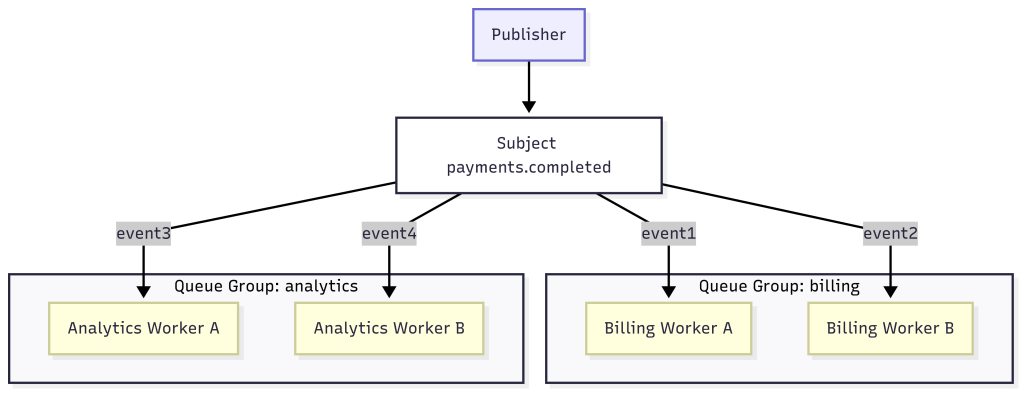
    • Subject: payments.completed
    • Queue group: payment-workers
    • NATS distributes payment events across a pool of workers for faster throughput.
  • IoT Device Commands
    • Subject: devices.cmd
    • Queue group: device-controllers
    • Only one controller handles a device command at a time.

Queue Groups vs Kafka Consumer Groups

If you’ve worked with Kafka before, Queue Groups in NATS will feel familiar. Both concepts aim to distribute messages across multiple consumers. But there are some important differences:

AspectNATS Queue GroupsKafka Consumer Groups
SetupVery lightweight, no extra configurationHeavier setup, needs brokers and Zookeeper/Kraft
DeliveryMessages go to exactly one subscriber in the groupEach partition is assigned to exactly one consumer in the group
PersistenceEphemeral (messages not stored) unless combined with JetStreamPersistent by default, stored on disk
ScalingAdd or remove workers anytime, messages are load balanced automaticallyScaling tied to number of partitions; can’t have more active consumers than partitions
Use CaseReal-time load balancing of tasks and jobsDurable processing of event streams with ordered partitions

Example Perspective

  • NATS Queue Group:
    Imagine an email sending service. Publishers push email tasks to email.send. Multiple workers in the mailers group share the load. If a worker is down, others pick up the tasks.
  • Kafka Consumer Group:
    Imagine a stream of e-commerce orders. The topic has 6 partitions. A consumer group with 6 members can process them in parallel, each consumer handling one partition. Messages are stored on disk and can be replayed later.
See also  Introduction to NATS: A Lightweight Messaging System

Final Thoughts

Queue Groups in NATS give you simple yet powerful load balancing. They work naturally with subjects, and you don’t need to configure anything complex. Just join workers under the same group name, and NATS does the rest.

Related posts:

Request–Reply in NATS: One-to-One Messaging

Publish–Subscribe in NATS: Simple and Powerful Messaging

NATS JetStream: Persistence and Streaming Made Simple

Pages: 1 2
Category: NATS

Leave a Reply Cancel reply

Your email address will not be published. Required fields are marked *

Linkedin

Widhian Bramantya

Recent Posts

  • Smart Automation in PostgreSQL: Managing Time-Based Data with pg_partman and pg_cron
  • Understanding PostgreSQL WAL, Slot, Publication, LSN, and Replication Lag
  • PostgreSQL Write-Ahead Log (WAL): Durability, Performance Tuning, and Recovery Explained
  • PostgreSQL Replication Deep Dive: From High Availability to Multi-Master Clusters
  • Finding Nearby Merchants in a Ride-Hailing App Using Elasticsearch Polygon Search
  • Advanced Text Search in Elasticsearch: N-Gram, Reverse, Fuzzy, and Search-as-you-type
  • Understanding and Customizing Analyzers in Elasticsearch
  • Log Management at Scale: Integrating Elasticsearch with Beats, Logstash, and Kibana
  • Index Lifecycle Management (ILM) in Elasticsearch: Automatic Data Control Made Simple
  • Blue-Green Deployment in Elasticsearch: Safe Reindexing and Zero-Downtime Upgrades
  • Maintaining Super Large Datasets in Elasticsearch
  • Elasticsearch Best Practices for Beginners
  • Implementing the Outbox Pattern with Debezium
  • Production-Grade Debezium Connector with Kafka (Postgres Outbox Example – E-Commerce Orders)
  • Connecting Debezium with Kafka for Real-Time Streaming
  • Debezium Architecture – How It Works and Core Components
  • What is Debezium? – An Introduction to Change Data Capture
  • Offset Management and Consumer Groups in Kafka
  • Partitions, Replication, and Fault Tolerance in Kafka
  • Delivery Semantics in Kafka: At Most Once, At Least Once, Exactly Once

Recent Comments

No comments to show.

Archives

  • October 2025
  • September 2025
  • August 2025
  • November 2021
  • October 2021
  • August 2021
  • July 2021
  • June 2021
  • March 2021
  • January 2021

Categories

  • Debezium
  • Devops
  • ElasticSearch
  • Golang
  • Kafka
  • Lua
  • NATS
  • PostgreSQL
  • Programming
  • RabbitMQ
  • Redis
  • VPC
© 2026 Widhian Bramantya | Powered by Minimalist Blog WordPress Theme